How to create great social media content for government brands

Learn how to create engaging and practical social media content for government brands.
TL;DR:
- Creating social media content for a “boring” industry doesn’t mean your content has to be boring.
- Use analytics to earn more creative freedom, put your community first, and look outside your industry for inspiration.
- With the right angle, even complex or less exciting topics can become content people actually want to stop and engage with.
Does creating social media content for your industry sometimes feel like trying to make watching paint dry interesting?
Maybe you work in government, finance, insurance, manufacturing, or another industry that isn't exactly known for viral TikToks and meme-worthy moments.
So how do you package that information in a way that makes people want to stop scrolling? We’ve got you!
During HeyOrca's recent Content Creation Bootcamp, Caitlin O'Higgins, Social Media Strategist at the National Capital Commission and Statistics Canada, shared her approach to creating engaging social content – even when the subject matter might not seem particularly exciting at first.
Her advice came down to 3 things:
- Earn permission to be creative
- Build a better content ideation process
- Stay inspired, even when the topic feels less interesting
Let's explore each of these in more detail.
1. Earn permission to be creative
Sometimes, the biggest barrier to creating better content isn’t a lack of ideas; it’s getting them approved.
If you work in an industry with multiple stakeholders, senior leadership, or strict review processes, you probably know the feeling. You come up with a fun idea, and somewhere between the first draft and final approval, all the personality disappears.
So, how do you convince people to take a few more creative risks? Show them the receipts.
Caitlin recommends consistently reporting on your analytics so you understand what’s working – and what isn’t. When a post performs well, don’t just celebrate it and move on. Save it.
Keep track of:
- Posts that outperform expectations
- Comments and reactions from your community
- Internal wins and case studies
- Experiments that led to better results
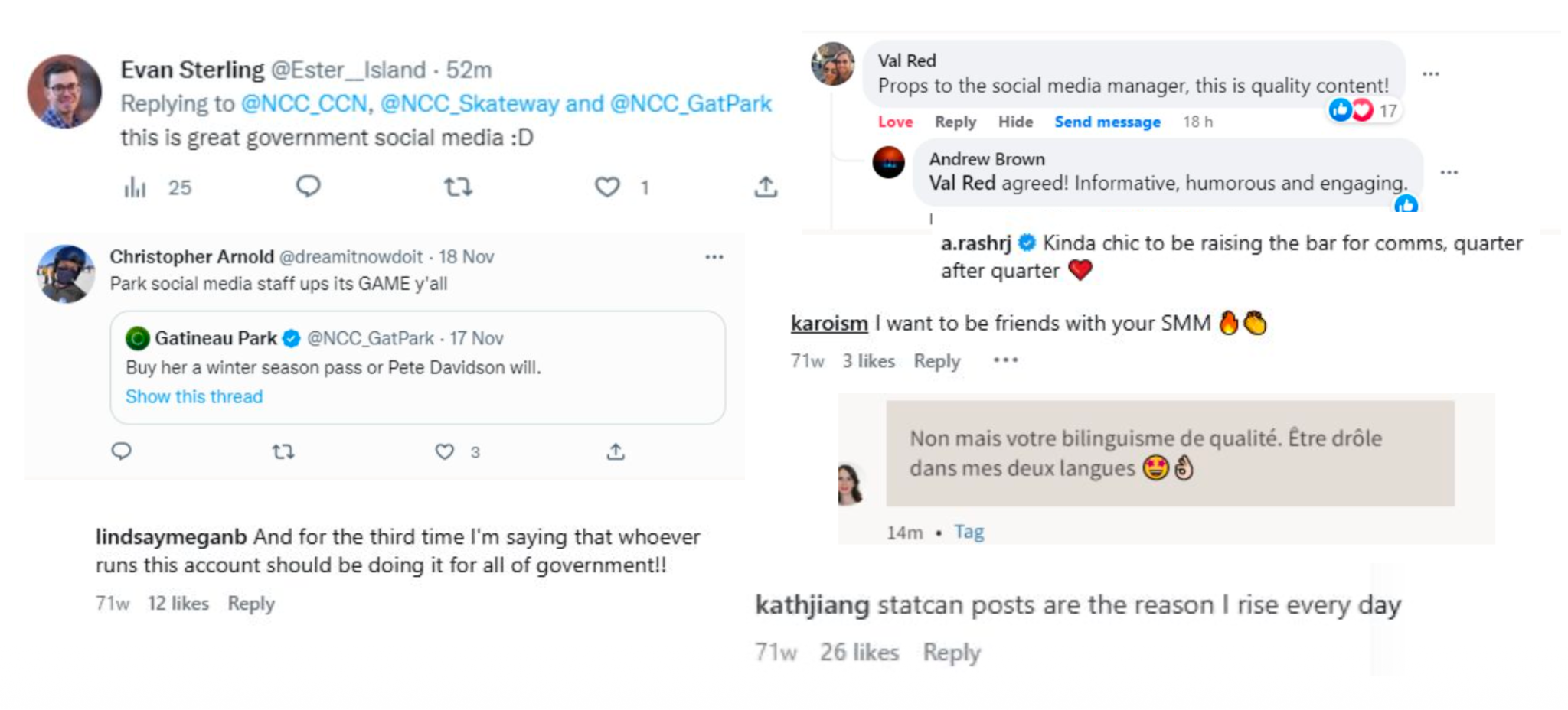
Basically, build yourself a screenshot hall of fame.
Those small wins can help you make the case for bigger experiments later.
Because “I think we should try this” is one thing while “Here are 5 examples of creative content that resonated with our community” is another.
Analytics can help you understand why a post flopped or slayed. But they can also give you the proof you need to earn more creative freedom.
Start small. Test an idea. Share the results. Then use that win to push the next idea a little further.
2. Build a content ideation process that leaves room for creativity
Great content ideas don't always appear while you're staring at an empty content calendar.
Especially if you're responsible for communicating complex information or working with multiple stakeholders.
That's why Caitlin recommends having a process that gives you structure and leaves room for creativity.
Start with content planning
Meet regularly with stakeholders to understand what needs to be communicated. Build out your calendar, identify upcoming moments, and look for trends or cultural events that could connect to your content.
But don’t stop there!
Once you know what you need to communicate, ask yourself: “Why would someone care?”
That question can completely change your approach.
Make space to workshop ideas
Once you know what you need to talk about, now is the time to give yourself room to explore.
Draft a few different options, get a second opinion, spend time online, and see how other creators and brands are telling stories.
And don’t forget to look outside of your industry.
If you work in insurance, you don’t only need to follow insurance companies. If you work in government, you don’t only need to look at government accounts.
You aren't looking to copy someone else's content.
You're looking at how they tell stories.
Maybe they use a great hook. Maybe they turn complicated information into a simple visual. Maybe they're great at answering questions their community is already asking.
You can take inspiration from the format, storytelling technique, or creative approach and make it your own.
Create a review process that protects the idea
For many “boring” industries, reviews are necessary.
Content might need to be fact-checked, reviewed by subject matter experts, translated, or approved by leadership.
Caitlin’s advice? Make sure you have good systems and workflows in place, allow for quick approvals, and protect the details, tone, and humour that made the idea interesting in the first place.
Because there’s nothing worse than a great idea going into the approval process and coming out as a corporate press release.
3. Plan for cultural moments
Not every piece of content needs to start from scratch.
Sometimes, you already have the information. You just need a more interesting way to tell the story.
Caitlin shared how Statistics Canada looks ahead for cultural moments and finds relevant connections to the information they already have.
The process looks like this:
- Look ahead
- Find a connection between the moment and your material
- Publish when attention is high
For example, an upcoming holiday, sporting event, movie release, or awareness day might give you a new angle for information you already have.
The key is finding a connection that makes sense.
Don’t force your brand into every trending moment. But when there’s a genuine connection, use it to make your expertise more relevant and easier to understand.
Sometimes, you don’t need a completely new content idea.
You just need a more interesting way into the story.
4. Put your community first
This might be the most important step you can take.
Instead of asking: “What do we need to communicate?”
Ask: “Why would someone care?”
That doesn’t mean your organization’s priorities don’t matter. It just means you need to translate those priorities into something that matters to the people you’re trying to reach.
- Start by removing the corporate jargon
- Write in your community’s language
- Lead with the most interesting detail
- Adapt the story to the platform you’re posting on
Also remember that the same piece of information doesn't have to look identical everywhere.
A complicated topic might work as a carousel on Instagram, a conversation starter on LinkedIn, and a short video that answers a common question on TikTok.
You don't need to change the facts.
You need to change the way you tell the story.
Instead of starting with the formal announcement, look for the thing that might make someone stop scrolling.
It could be:
- A surprising statistic
- A common misconception
- A question people are already asking
- A behind-the-scenes story
- A problem your community can relate to
5. Look for inspiration everywhere
When you create content about the same industry every day, it can start to feel like you've covered everything.
You haven’t – you might just need to look somewhere new.
Caitlin recommends looking for inspiration outside your industry and creating systems that support creativity.
That could mean:
- Saving posts you love to an inspiration folder
- Sharing interesting content with your team
- Keeping a running list of ideas
- Reviewing your top-performing content regularly
- Following creators outside your industry
- Trying a new format with a familiar topic
The goal isn’t to reinvent the wheel every week.
Sometimes, a new format can completely change how people experience an old topic.
A complicated piece of information might work better as a simple carousel. A common question might become a video. A dry statistic might become the punchline to a joke.
The information stays the same.
The experience changes.
3 things you can do tomorrow
If you’re feeling stuck creating content for a “boring” industry, you don’t need to completely rebuild your strategy.
Start here.
1. Check your analytics
Look at what has already worked.
Find the posts that sparked comments, shares, conversations, or stronger engagement. Use those insights to understand what your community responds to – and to build the case for more creative experiments.
2. Make your next idea audience-first
Before you publish your next post, ask yourself:
Why would someone care about this?
If the answer isn’t obvious, keep working on the angle.
Remove the jargon. Find the interesting detail. Connect the information to something your community already cares about.
3. Borrow inspiration from somewhere unexpected
Find a creator, brand, or account outside your industry that consistently makes you stop scrolling.
Don’t copy their content.
Instead, ask: What are they doing that makes this interesting?
Maybe it’s the format. Maybe it’s their storytelling. Maybe it’s how they lead with curiosity.
Then see how you can apply that approach to your own topic.
Psst! Here are 3 brands in ‘boring’ industries that will inspire you.
FAQs
What should government organizations post on social media?
Government organizations can share useful information, answer common questions, debunk misconceptions, highlight the people behind public services, and connect their expertise to timely or cultural moments. The key is to focus on why the information matters to the community rather than simply sharing a formal announcement.
How can government social media be more engaging?
Start by putting your community first. Instead of asking, “What do we need to communicate?” ask, “Why would someone care?” Remove corporate jargon, lead with the most interesting detail, and adapt the content to the platform and audience.
How do you make a “boring” industry interesting on social media?
Look for the stories, expertise, and human moments behind the industry. Use formats and storytelling techniques that work outside your industry, experiment with different approaches, and focus on creating content that is useful, relatable, entertaining, or relevant to your community.
How can social media managers get approval for more creative content?
Use analytics to build your case. Keep track of successful posts, positive comments, and experiments that performed well. These small wins can help demonstrate what your community responds to and give you evidence to support bigger creative ideas.
What type of content works best for government social media?
There isn't one format that works for every organization, but educational content, myth-busting, behind-the-scenes stories, surprising statistics, answers to common questions, and content connected to relevant cultural moments can all help make government information more engaging.
How can social media managers stay inspired when creating content for the same industry?
Look outside your industry for inspiration. Follow creators, brands, and organizations that create content you enjoy, then study how they use hooks, storytelling, humour, or different formats. Borrow the technique (not the content) and adapt it to your own expertise.
Summary
Creating social media content for a less-than-glamorous industry can come with challenges.
You might have more approvals, more complex information, more stakeholders, and topics that don’t naturally lend themselves to trends. But those challenges don’t mean you’re stuck creating boring content.
You have expertise that other people don’t, you have stories worth telling, and you probably have information that could genuinely help your community.
The trick is getting that value out of the corporate jargon and into a format people actually want to engage with.
So, the next time someone tells you that your industry is boring, feel free to disagree.
Because the industry probably isn't the problem, you just need to find the story worth telling.
Still paying per seat for your social media tool? With HeyOrca, you get unlimited users – so your whole team (and clients!!) can collaborate without the extra cost. Plan, approve, and schedule your next post now.
Every member of your team deserves a seat at the table. That's why every HeyOrca plan comes with unlimited users. Choose the social media scheduler that helps you create, collaborate, and build community – without worrying about extra fees. Start your free trial.
Build stronger social media communities. HeyOrca brings your whole team together – with unlimited users!! – to plan, approve, and schedule content in one place. See it come together in minutes.
Looking for a social media tool built for teams and agencies? Plan, approve, and schedule your next post in minutes with HeyOrca – no credit card required.
.png)
Close all those tabs
Use HeyOrca to manage your social media content, approvals, and community in one place.
*no card required







%20(3).png)

