6 community engagement metrics to start tracking

Learn how to measure community-led marketing with traditional marketing metrics that your boss will understand.
“How do you measure community?”
It’s one of the first questions marketers ask when they start exploring community-led marketing.
While traditional marketing has trained us to look for clear numbers: impressions, clicks, conversions, and revenue, community works a little differently.
So how do you know if your community-led marketing efforts are working if you can’t measure them the same way you measure traditional campaigns?
Luckily, there’s a way! You just need to rethink how you look at marketing metrics – starting with leading and lagging indicators.
What are leading and lagging indicators?
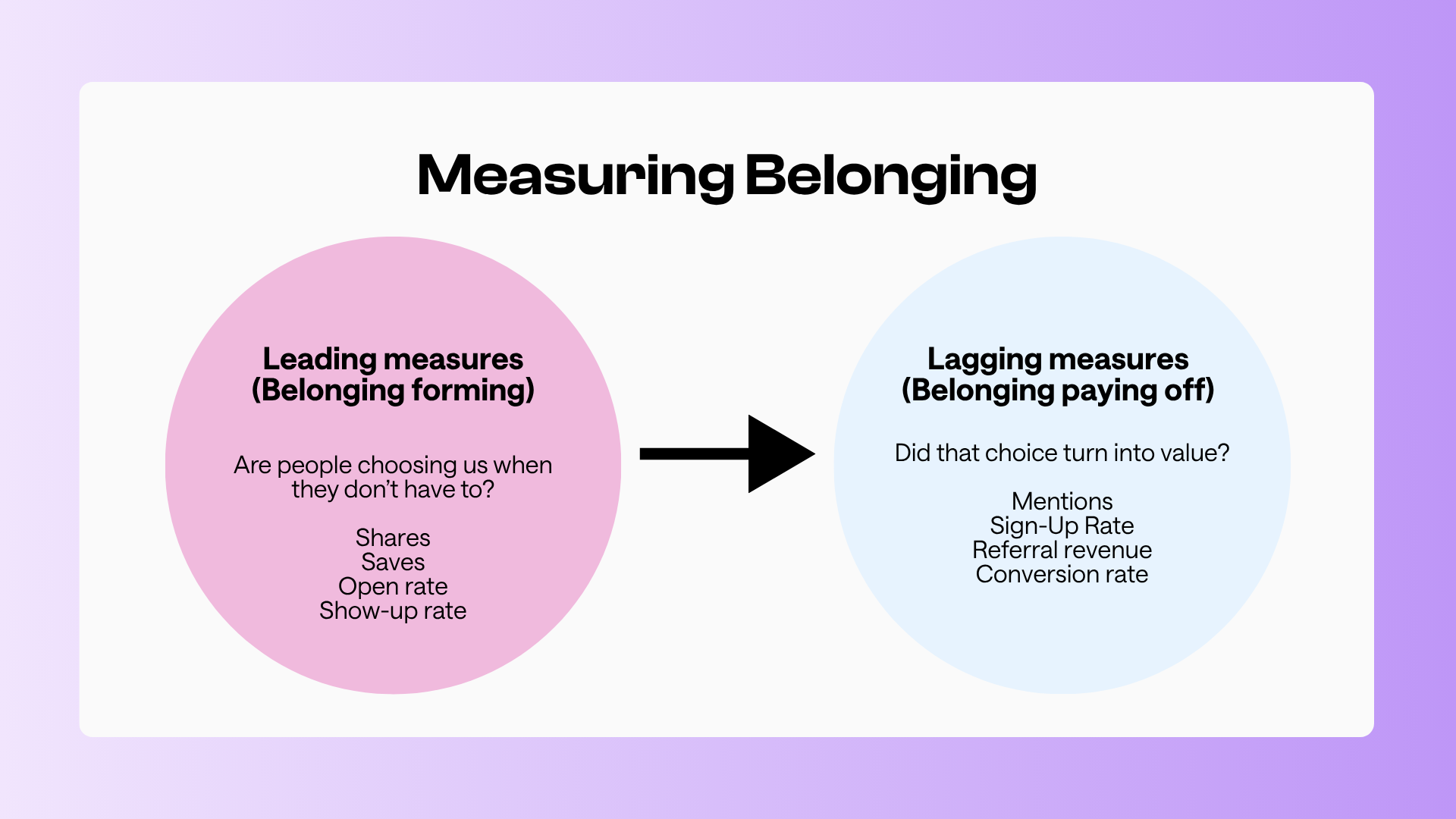
When measuring community, it’s important to look at both early signals and long-term business impact.
This is where leading and lagging indicators come in.
Leading indicators show momentum. They help you understand whether your community is active and engaged.
Examples include:
- Participation
- Community growth
- Brand mentions
- Conversations
- Event engagement
While lagging indicators show the business outcomes that happen over time.
Examples include:
- Revenue impact
- Customer retention
- Customer acquisition
- Referral growth
Together, these metrics tell the full story.
Orca tip: Leading indicators help you understand if your community is moving in the right direction. Lagging indicators show whether that momentum is creating measurable business results.
What are community-led marketing metrics?
Community-led marketing metrics are measurements that help you understand how people interact with your brand, each other, and the spaces you create.
Unlike traditional marketing metrics that often focus on reach and conversion, community metrics focus on relationships.
They help answer questions like:
- Are people actively participating?
- Are community members finding value?
- Are people becoming advocates?
- Is the community influencing business outcomes?
Because community is built through belonging, identity, and spaces, measuring community means looking for signs that those things are happening.
For example: a growing follower count doesn’t always mean a growing community. But a community member who shares advice, responds to a conversation, or recommends your brand? That’s a much stronger signal.
How to rethink traditional marketing KPIs
Also okay, just to make it clear; community-led marketing doesn’t mean throwing away the marketing metrics you already use.
Impressions, reach, website traffic, click-through rates, and conversions still matter. They help you understand awareness, interest, and customer behaviour.
The difference is in how you interpret those metrics.
A community-led approach looks beyond the number itself and asks what that number tells you about the people behind it.
For example:
Traditional question: How many people saw our content?
Community-led question: Did our content create enough value for people to engage, respond, or start a conversation?
Traditional question: How many people clicked through?
Community-led question: What made people take the next step, and how can we create more opportunities for connection?
Traditional question: How many conversions did we generate?
Community-led question: How did community activity influence trust, loyalty, or the decision to buy?
This is where community marketing KPIs come in.
Metrics like participation, advocacy, retention, referrals, customer feedback, and relationship growth help add context to your existing marketing data.
So when we’re thinking from a community-led marketing lens, we aren’t measuring something completely different; we’re just reframing how we understand the behaviours behind the numbers.
6 community engagement metrics to start tracking
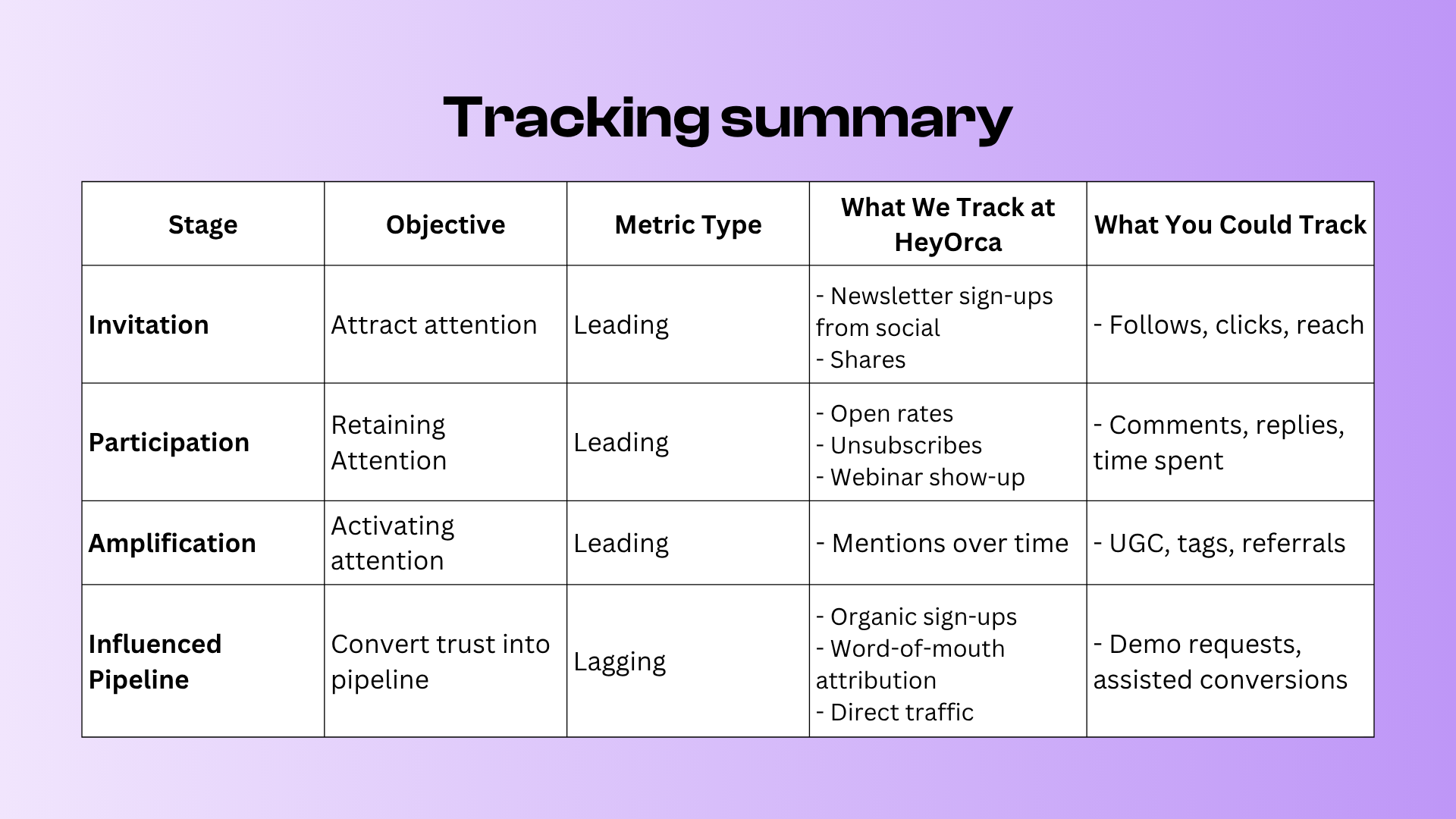
1. Participation metrics
Participation is one of the clearest signs that a community is becoming more than a place where people consume content.
Participation metrics can include:
- Comments and replies
- Questions from community members
- Event discussions
- User-generated content
- Newsletter responses
- Member-to-member conversations
The goal is to understand whether people feel comfortable joining the conversation.
For example: a post with 20 thoughtful responses may reveal more about community health than a post with thousands of views and no discussion.
2. Advocacy metrics
Advocacy happens when people share your message because they genuinely want to – not because they were asked.
Advocacy metrics include:
- Referrals
- Customer testimonials
- Brand mentions
- Community-generated content
- Organic recommendations
Advocacy is one of the strongest signals of community health because it shows that people don’t just recognize your brand, they feel connected enough to support it.
3. Retention metrics
Retention metrics help you understand whether your community continues to provide value over time.
To find out if your community is engaged, track:
- Returning members
- Repeat event attendance
- Active members month over month
- Newsletter engagement
- Customer retention
Orca tip: Growth matters, but retention tells you whether the foundation is strong.
4. Referral metrics
Referrals are where community activity starts connecting directly to business outcomes.
Track:
- How many customers come from referrals
- Referral conversion rates
- Community members who recommend your brand
- Word-of-mouth mentions
When someone recommends a brand they’re connected to, that recommendation carries a different level of trust than traditional marketing.
5. Customer feedback metrics
Your community can become one of your best sources of customer insight.
Instead of guessing what people want, listen to what they’re already telling you!
Look for:
- Common questions
- Repeated challenges
- Product feedback
- Content requests
- Conversations around customer needs
These insights can shape your content strategy, customer experience, and product decisions.
6. Community marketing ROI metrics
To measure community marketing ROI, connect community activity to business outcomes like:
- Increased retention
- Lower customer acquisition costs
- Higher referral rates
- More qualified leads
- Better customer insights
- Stronger brand loyalty
For example: someone might discover your brand through social media, join your newsletter, attend a webinar, participate in your community, and become a customer months later. Community helped create that relationship – even if it wasn’t the final conversion point.
How to measure community ROI
Start by connecting your community goals to measurable outcomes.
Ask: “What does success look like for our community?”
Then choose metrics that support that goal.
If your goal is customer loyalty:
Measure:
- Retention
- Repeat participation
- Member sentiment
If your goal is brand awareness:
Measure:
- Referrals
- Brand mentions
- Community growth
If your goal is better customer insights:
Measure:
- Feedback themes
- Conversations
- Member questions
Frequently asked questions
What are community-led marketing metrics?
Community-led marketing metrics measure how people engage with your brand, participate in your community, and contribute to business growth. Common metrics include participation, advocacy, retention, referrals, customer feedback, and ROI.
What are the most important community marketing KPIs?
The most important community marketing KPIs include engagement, participation, member retention, referrals, brand advocacy, customer feedback, and revenue impact. The right KPIs depend on your community goals and business objectives.
How do you measure community ROI?
You can measure community ROI by connecting community activity to business outcomes like customer retention, referrals, acquisition costs, and revenue growth. Community ROI is often measured over time rather than through a single campaign.
What are community engagement metrics?
Community engagement metrics measure how actively people participate in your community. Examples include comments, conversations, event participation, user-generated content, and member interactions.
What is the difference between traditional marketing KPIs and community KPIs?
Traditional marketing KPIs measure reach and conversions, while community KPIs measure relationships, participation, advocacy, and long-term engagement. Community metrics show how people move from awareness to involvement.
What are leading and lagging community metrics?
Leading community metrics show early signs of growth, such as participation, engagement, and brand mentions. Lagging metrics show long-term business results, such as retention, referrals, and revenue impact.
Summary
While traditional marketing metrics help you understand reach and performance, community metrics help you understand connection, trust, and long-term impact.
By tracking both leading indicators (like participation, engagement, and advocacy) and lagging indicators (like retention, referrals, and revenue impact), you get a clearer picture of how your community is supporting your business goals.
Want to learn how to build a community-led marketing strategy? Download our Community-Led Marketing ebook to explore how belonging, participation, and advocacy can help your brand grow.
Still paying per seat for your social media tool? With HeyOrca, you get unlimited users – so your whole team (and clients!!) can collaborate without the extra cost. Plan, approve, and schedule your next post now.
Every member of your team deserves a seat at the table. That's why every HeyOrca plan comes with unlimited users. Choose the social media scheduler that helps you create, collaborate, and build community – without worrying about extra fees. Start your free trial.
Build stronger social media communities. HeyOrca brings your whole team together – with unlimited users!! – to plan, approve, and schedule content in one place. See it come together in minutes.
Looking for a social media tool built for teams and agencies? Plan, approve, and schedule your next post in minutes with HeyOrca – no credit card required.
.png)